Sunday, September 11, 2016

Sunday in Negros Occidental


Jonathan and I boarded a plane early on Saturday and flew to Bacolod City on the island of Negros (the “Occidental” portion). We had only gotten about two and a half hours of sleep the night before after the end of the classes, finishing the business necessary, and getting packed for the trip. Between that and the sleep deficit built up through the week of classes in Cebu, we were both exhausted when we arrived in Bacolod. Since we had arranged for no schedule on Saturday, we spent the day catching up on sleep. We went to eat supper and then went back to sleep for the night. By this morning, I felt revived and ready to go, though still nursing a very sore throat.

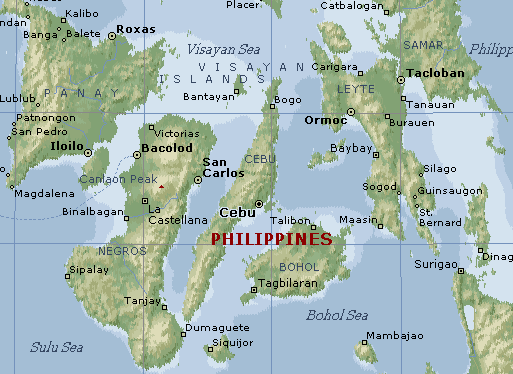
This morning (Sunday), Jonathan Carino and I were driven by Jack Jaco to his place for worship in Victorias City, on the northwest extreme of Negros Island. The congregation there meets in a room that is built on to Jack and Adel’s home. Jack has been a dear friend and co-laborer for many years, especially after the death of our esteemed brother Cipriano Carpentero. He stepped in at that time and has continued to work with us on most trips due to his good knowledge of Scripture and his mastery of several dialects used in the Philippines. It was my first time to see his sweet wife since she had a very serious medical problem that we feared for a while was life threatening. We thank God that her health was restored and she seems back to full strength. All three of their now grown children (Jireh, Shalom and Shammah) were there today. It was the first Sunday back at home for Shalom and Shammah after being gone for several years to be nurses in Saudi Arabia. (They were highly decorated there for the jobs they did and offered lucrative extensions of their contracts, but they are looking for employment where they can have greater freedom to worship with the saints and grow in the Lord.) All of the children, but especially Shalom and Shammah, have developed a very close relationship with me and call me their “Uncle Harry.” It was so good to see them safely back in the Philippines and hungering for spiritual things. The girls bought me a very special and dressy “barong,” a long-sleeved shirt that is used for special occasions. I wore it for worship today.

Both Jonathan and I were asked to preach in the worship. I was the first and delivered a lesson on “Characteristics of a Life of Faith” from Hebrews 11:13-16. The lesson followed the outline given by the text in verse 13:

·      Not having received the promises…
·      But having seen them afar off…
·      Were assured of them, embraced them…
·      And confessed that they were strangers and pilgrims on the earth

The passage encourages us to grow in our faith through understanding the promises of God and accepting them as a reality, not doubting and failing in our faith. We are urged to keep heaven in sight as our goal and see it as the place of our true citizenship. John preached next on how to identify a strong church. He first noted that it was not by numbers, money, social things or an organization added by man. He showed from Scripture that it was by education from God’s word, working with diligence for the Lord, consecration in the lives of the members and vision to continue growing in the labor of edification and evangelism. It was an edifying service! Though I could not understand every word of John’s lesson, I could easily follow most of it as his projected outline was in English.

After lunch, we proceeded to a congregation on the southern edge of Bacolod where Shem Tagapan labors. Shem impressed me as outstanding the first time I met him and that assessment has only been confirmed each time I have seen him since then. To get to the meeting place, one must drive off of the highway down a long road that is only wide enough for one vehicle at a time to pass (like the driveway in front of a one-car garage.) After getting to the area, one must walk for some distance on an uneven dirt path. They also meet in a room that Shem has added onto their house. The church has grown through the years and now almost fills the available space. Shem was teaching when we arrived. I was asked to give a lesson after Shem finished. Since the bulk of the congregation does not understand much English, I presented a shortened lesson on “What Is Necessary to Hear the Lord’s Voice” from Hebrews 3:7-15. After writing the outline on the board, along with passages used, I gave a short sermon from the points of the text. Jack Jaco followed with a summarizing of the lesson in the Ilongo dialect spoken in this area. We then returned to the hotel to rest and make preparations for tomorrow’s lectures.
 
Thank you again for all of the help you have provided in support and prayers to make this effort possible. I am keeping all of you in my prayers as you will begin your worship on that side of the globe in a few hours. I am also remembering the great loss suffered by our country just 15 years ago on this day and the continuing effect on those in our Armed Services who sacrifice so much to keep us free. God bless!

Friday, September 9, 2016

End of Classes in Cebu City

As we started the last day of our classes, we were ahead of schedule for the week’s studies. So, it was much easier to finish the material than it has been in other classes when we fell behind. These students were quick to catch on to the material and that made our plan of study easier to fully cover. Actually, we went into greater depth than I thought possible in several areas.

We studied 2 Peter 2 and 3 in the morning session. We noted from the context that the “false teacher” of chapter two is identified as such because his teaching is false. We saw that the term “false teacher” is not reserved for one who has an exceptionally corrupt character or false motives. The text parallels it with the term “false prophet” regarding those in the OT. It is not that the term “false prophet” was reserved for an exceedingly wicked few, since the term “false prophet” is never found in the OT. So, how are we to recognize a “false prophet” from the OT? The very simple fact is that we recognize one as a “false prophet” in the OT when he prophesied falsely. In the same way, we recognize a “false teacher” by seeing that he teaches falsely. Though the corruption or evil mentioned in the text may be present or may develop over time, the false teacher is identified in the first few verses by the destructive nature of his teaching or the destruction he brings on all who follow his teaching. We noted the parallel to 2 John 9-11 and the need to reject those who teach error from our fellowship. (Our classes in Manila scheduled for November will examine this point more fully as we study the Epistles of John and the subject of “Fellowship.”) Rody, Lordy and Jonathan finished the morning studies with another excellent time of discussion.

The afternoon session finished the examination of Premillennialism by looking at Psalm 110 and the use of that psalm in the NT. We surveyed the NT use of this psalm to see at what point Jesus “sat down at the right hand of God” (picturing the coronation or beginning of Jesus’ reign as King of His kingdom) and how long that reign lasted. We saw that it began after His Ascension (Mk. 16:19; Acts 2:33-36; 7:55) and will end at His coming in the resurrection (1 Cor. 15:24-26). We also considered what the NT teaches concerning when Christ became the “High Priest after the order of Melchizedek” per Psalm 110. When properly understood and applied, Psalm 110 and its fulfillment clearly shows the basic errors of both Premillennialism and the “A.D. 70 Doctrine” (also called “Realized Eschatology”).


Though all of us were extremely tired from the work of this week, we were also sorry to see this study come to an end. I want to express my deep thanks to all of you that helped to make this effort possible and the students in these classes also asked me to express their thanks for your sacrifices on their behalf.

Thursday, September 8, 2016

Classes Progressing


With the end of the classes drawing near, we seem to have formed a good routine with all being well adjusted to the schedule. The outlines are getting better each day and the students are quicker to grasp the points in the classes. The camaraderie of the students is also evident, though many of them had not met each other previous to this week. They now have a good working relationship and a respect for one another by virtue of their shared labor in the Lord.

I was about 15 minutes late getting to the classes this morning as my vertigo and fatigue were worse this morning, but both cleared up after I had been teaching for about 30 minutes. As many of you know, I have been on a very strict diet in order to prepare for a probable surgery after my return from a November trip to the Philippines for more classes of this type in Manila. That diet has been impossible to keep exactly as I do it in the U.S. because some of it is unavailable here. So, I have done the best I could, but am having to adjust a few things that have proven to be problematic. Hopefully, I will get those problems resolved before the next trip begins on October 31, the Lord willing.

The Epistles of Peter class covered the last part of 1st Peter and the first chapter of 2nd Peter today. We saw the great encouragement and exhortations to be found in Peter’s conclusion of the first epistle urging them to a greater service of faith as they lived in hope of the promises of God. We then shifted to the second epistle and noted the character of a Christian as we are told to grow in the grace commanded of God for those who would make their calling and election sure. The last part of the morning class was spent in examining the inspiration discussed in the closing part of 2 Peter 1. Jonathan, Rody and Lordy then took over for their part of leading the discussion and clarification period to end the morning session.

In the afternoon session on Premillennialism, we covered four basic questions:

·      Does the Bible teach the “rapture – revelation” distinction claimed in Premillennialism?
·      When and what is the tribulation of the Bible?
·      When will the righteous & unrighteous be raised from dead?
·      Does Bible teach literal 1000-year reign of Christ on earth?

We noted specific passages that denied premillennial teaching in each of these areas. This was the first time some of these men have been involved in a detailed examination of the false doctrine of Premillennialism. Some have been confused by the teaching received while in the denominations and have expressed that these principles help them more clearly see the truth and will enable them to teach others as well. I left a little early this afternoon to let John, Rody and Lordy have more time to discuss the material covered on Premillennialism with the students in their dialects.

On the way back to the hotel, we passed the area for two of the big Catholic churches here in Cebu. They were packed and I wondered why so many were out today. I learned something interesting about September 8 from the Catholics – it was the day Mary the mother of Jesus was born! You may have missed that piece of information in your Bible just as I missed it in mine, so I thought you might be interested. :-) Strange how religious error can observe things not even found in Scripture, then ignore things that are plainly and specifically taught in Scripture. How sad!

Wednesday, September 7, 2016

Mid-Point for Classes

Today was the most difficult for me personally since my fatigue seemed to catch up to me and I was not feeling well most of the day. Yet, the classes seemed to evidence more good today than in the previous days. My hope is to get my “second wind” by tomorrow and catch up to the class. Their assigned outlines and their comments show that they are growing well and showing the evidence of that growth.

The morning session started in 1 Peter 4:1 and covered through 1 Peter 5:5. We spent a great deal of time in 4:1-6 talking about the words used in condemnation of the sins of a sexual nature and those involving the use of intoxicants. We noted that the Bible condemns, not only the end effect of these evils, but also the start or initial step into that path. We also gave emphasis to 5:1-5 in identifying what the Bible says about elders, shepherds or overseers as well as showing their work. We also noted the contrast between the Bible teaching about their function and that practiced by our institutional friends in their practice of the “sponsoring church” or an eldership’s oversight of a separate “mission church” in an entirely different place (sometimes a different continent).

The afternoon session on Premillennialism focused on answering three main questions:

·      Was the rejection of Christ unexpected or prophesied before Christ’s coming?
·      Was the church an afterthought or part of the eternal plan of God?
·      Are the church & kingdom different groups or the same group of people?

We answered each question by noting that the Scripture teaches the opposite of what Premillennialism claims. In answering the last question, we observed that Jesus placed the Lord’s Supper in the kingdom (Luke 22:15-20, 28-30). But the Scripture records that the Lord’s Supper was partaken in the church (1 Cor. 11:17-34; Acts 20:7). How can that be explained unless we understand that the church and the kingdom are comprised of the same people?

Jonathan, Rody and Lordy again did an excellent job of conducting both morning and afternoon sessions to clarify points in the dialects of the participants. On the first day, the students were a little hesitant to ask questions and seek clarification, but that is no longer the case. They have good discussion periods with much participation and they have to be stopped after running some over the allotted time of each session. We all believe that is the best change we have made for the classes this time and it is turning out better than I had even hoped!

Thanks to all of those who have helped make these classes possible. We also appreciate so very much your prayers for this effort.